Podcast Format
- Sources
- Biography
- Conquistadores
- No me digas
- Ortodoxia
- El Rey-sto
- ¡Fuero o Fuera!
What do you know about Spanish history?
- Native populations – Iberians and Celts
- A few cities from larger nations, but not part of empires (Phoenicia, Greece)
- 1st Punic War led to Carthaginian colonization of Spain
- Greek complaint about Carthaginians led to 2nd Punic War and Roman control of Spain
- Visigoths
Describing Spain
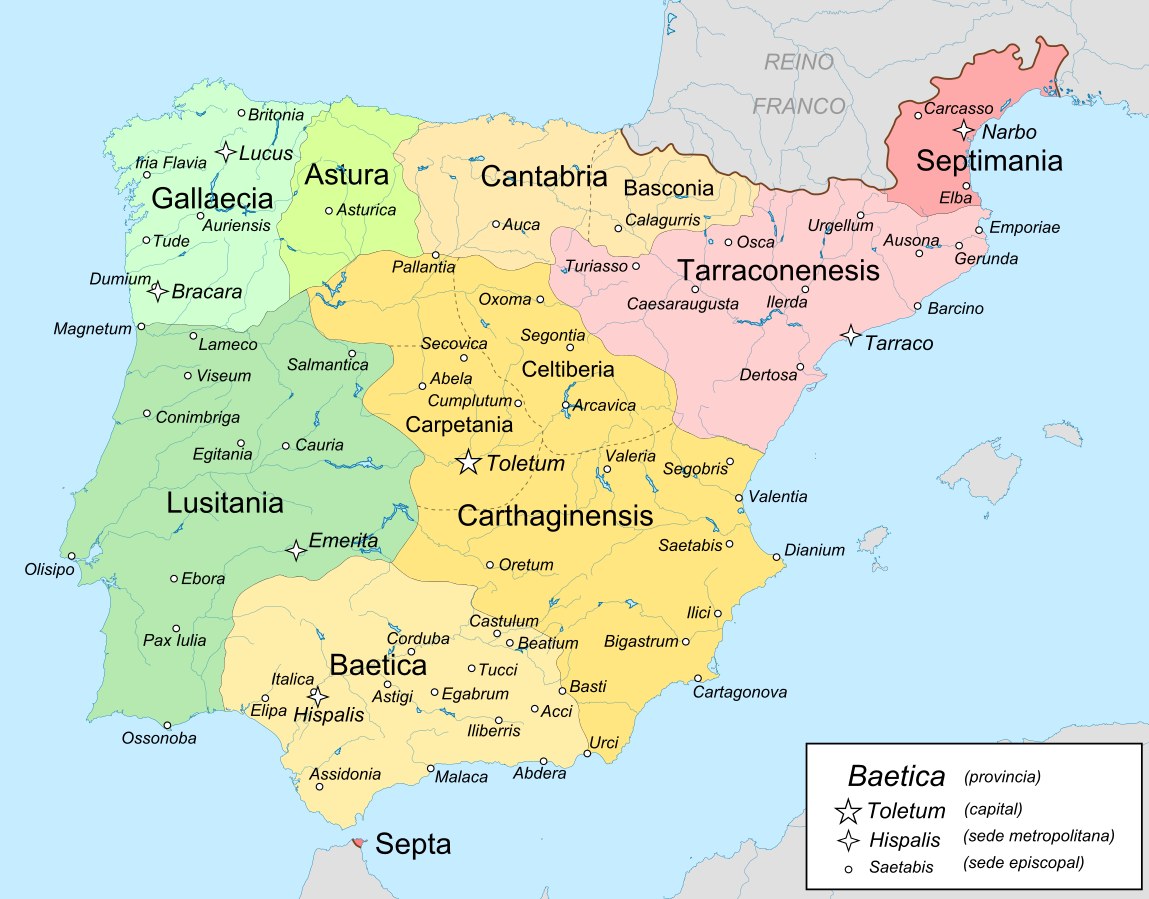
We’re going to take a moment to talk about geography. A lot of podcasts will just introduce places and events without really specifying where everything is, so I thought I’d start this podcast differently, by talking about the geography of the Iberian Peninsula. So, listeners, you can break out a map of Spain if you like, or if you know what it looks like really well already you can imagine it as I’m talking, or you can picture an upside down pentagon – with unequal angles like a home plate in baseball. Basically think of a triangle on top of a square, or like the outline you make when you draw a house, and then flip it upside down so the point of the triangle is pointing down. This is the Iberian Peninsula.
So we’ll start at that bottom point: this is roughly the location of the Rock of Gibraltar. In real life it’s not actually the most southern point in Spain – that’s actually a town called Tarifa. Now below the bottom point of Spain is the Straight of Gibraltar, which is only 8 miles or 13 kilometers wide, so you can see Africa from Tarifa, and in fact if you are on the top of the Rock of Gibraltar, your cell phone will send you a welcome to Morocco message and a reminder of roaming charges. Regardless, the rock is not known as Gibraltar yet at this point in our story. It, and the mountains on the African side of the Straight, were called the “Pillars of Hercules” by the Roman world. They marked the end of the known world to the Mediterranean cultures, although people did sail past them and up the coast in the Atlantic – just not out into open sea.
Most of the area in this lower triangle of Spain is the region of Andalucía, maybe going halfway up each of the sides of the triangle. This is where your famous cities of Seville, Córdoba, and Granada are. At our point in history this region is the province of Baetica, which is what the Romans called the province.
Moving clockwise, we get to the left or west coast of the peninsula. To the left we have the Atlantic Ocean. We start moving up – almost this entire side is modern-day Portugal, but at the time it was considered part of Hispania and it was called the province of Lusitania. Lusitania is most of that left side of the pentagon, but also encompasses a lump further inland which is the current region of Extremadura. And then in the top left, or northwest of the pentagon, we have basically a square area in the corner which is not part of Portugal/Lusitania, and this is Galicia. It was called Gallaecia by the Romans, and it’s still called that all the way to today. This area was hard for the Romans to assimilate, and at our current point in history, it is its own kingdom with its own king, whom we will meet in our first episode.
Moving across the top of Spain we have the Bay of Biscay to the north, and then even further north we have a bit of France that sticks out, Brittany actually. Along the north coast there’s some lowlands, and then not far inland, to the south, there is a mountain range called the Picos de Europa, or the Peaks of Europe. So the strip of land between the sea and the mountains has historically been a good place to hide from conquerors. The indigenous population did it when the Romans came, so this area, like Galicia, was only very lightly Romanized. And then the Christians did it when the Muslims came. So, going left to right, we have the regions of Asturia and Cantabria, which have the same names now as they did then.
Halfway across the top line of the pentagon there we have another mountain range – the Pyrenees. North of the Pyrenees we have modern-day France, so if you mentally want to attach one side of a hexagon to the upper-right section, knock yourself out. Right now France is ruled by several kingdoms of the Franks. On the Spain side of the border, we have the Basque Country, again, has always been there and called that. These are the modern-day regions of País Vasco, Navarre, and La Rioja. They are also currently doing their own thing – they don’t have a king like Galicia, but they are not part of the Gothic kingdom.
Heading down around the top right corner we have the modern regions of Aragón and Cataluña, which at the time was called Tarraconenesis. Cataluña is on the right or east coast, which is the Mediterranean Sea. Going down that coast we hit the modern regions of Valencia and Murcia, and actually at this time in history, they are not controlled by anyone Spanish – the Byzantine Empire holds most of that coastline. And then we’re back at Andalucía/Baetica again.
The middle of the country in modern times is known as Castille, which is why sometimes the Spanish language is called Castillian. Currently there are 3 regions in it – from northwest to southeast they are Castilla-León, Madrid, and Castilla-La Mancha. This central area was called the province of Carthaginensis at the time. I want to point out that Madrid is not a thing yet – the biggest and most important city here is Toledo, which is just south of where Madrid will be – easy day trip from Madrid, you can take the train, it’s like 30 minutes if I remember correctly.
Three other geographical things I want to mention. First, if you’ve been counting, I’ve only mentioned 15 modern regions of Spain, and there are currently 17 autonomous communities. The last two are island chains. The Balearic Islands are in the Mediterranean, not far from the Valencian coast. They’re Byzantine right now. The Canary Islands are out in the Atlantic Ocean off the southwest coast of Morocco, and we won’t be talking about them for another 800 years. And finally, there is one bit of modern-day France that we will be discussing for a bit, and that is a region known as Septimania. It’s north of the top-right corner of Spain, and it contains the cities of Narbonne and Toulouse. Toulouse was the historical capital of the Goths, so this region remains under Gothic control for historical reasons.
The Visigoths
The first post-Roman kingdom in the Iberian Peninsula is the Visigoths, but they aren’t native to the area at all. The Goths were what the Romans called barbarians, which is what they called basically every non-Roman, and barbarians lived in just one corner of Europe. If you study Roman history or listen to Totalus Rankium’s first season, you’ll hear a lot about the Rhine legion and the Danube legion – these were the military contingents based on the Roman sides of the aforementioned two rivers to handle barbarian raids. Geography again: the Rhine starts at the north of Europe and goes north-south-ish straight down modern day Germany – to the west is Roman and to the east is barbarian. And the Danube starts at the Black Sea above modern day Turkey and goes roughly east-west-ish below Romania, above Serbia, and across Hungary and Austria – to the south is Roman and to the north is barbarian. So, yeah, the corner of Europe that has most of Germany, all of Poland, Lithuania, Belarus, Romania, Ukraine, Czech Republic, Slovakia, that square there, is barbarian-land, and that’s where the Goths came from.
The Goths came specifically from the bottom-right of that square, so Romania, Moldova, Ukraine areas. The Visigoths, or Western Goths, were more in the eastern part of Romania, while the Ostrogoths, or Eastern Goths, were more in the southern part of Ukraine. They got called Eastern and Western Goths because of where they later ended up, but for right now, they are living right to the north of the Danube River. Being so close to Rome means that there was a lot of interchange, both good and bad, between the two cultures – the Goths raided south of the Danube all the time, as well as being hired to fight in the Roman army against the Persians, for example.
In the mid-to-late-300s, though, the Goths wanted to move south more permanently and live within the Roman empire. This was because the Huns, of Atilla fame, were on the move, and the Goths wanted protection from them. They were allowed by the emperor, Valens, to move into the empire, but the immigration process was handled horribly and the Goths ended up going to war against Valens at the Battle of Adrianople. Goths won the battle, but didn’t gain any more protections or access to resources in the wider war.
Eventually, a man named Alaric was chosen to be king by some of the Goths – these are the ones who became known as the Visigoths. Alaric took up the fight to have a safe area for the Goths to live in. The emperor at the time, Honorius, was against this, and his general Stilicho went to war against Alaric and the Goths many times, culminating in Alaric’s sack of Rome in the year 410. Even so, Honorius was against giving up any land or power to the Goths, until some OTHER barbarians swept into the Iberian Peninsula. Alaric had died by this point, but Honorius granted the Goths territory in southwest France, just over the Pyrenees, so they could raid into Hispania and get the barbarian invasion under control.
So now the Goths are settled in southern France as foederati of the Roman Empire, and they keep Spain settled for a while, and even help keep the Huns out of Western Europe. Then . . . the Western Roman Empire falls. But the Visigoths keep going on, ruling over Southern France and keeping an eye on Spain. But there’s pressure from the northeast from the Franks, another barbarian tribe that has moved into France. The Visigoths and the Franks end up going to war and the Franks beat the Visigoths in 507, kicking them almost entirely out of France. The king and the nobles flee across the Pyrenees to Barcelona and eventually to Toledo, with the help of the Ostrogoths, who are in Italy by this point. As a result of this, the Visigoths rulers were basically puppets of the Ostrogoths for many years. This brings us to our current point in history.
So why did I decide to start here, rather than with Alaric or after the Battle of Vouille? Well, first of all, I didn’t think I could improve on the wonderful episode that Totalus Rankium already did about Alaric – I mean, Stilicho – I mean, Honorius. And I didn’t want to start in 507 because almost immediately after that, the Visigoths have a regency that was completely controlled my the Ostrogoths, and for a while afterwards, on and off, the Visigothic rulers are just puppets of the Ostrogoths. In addition, it’s not until Leovigild, our first ruler, that the Visigoths really controlled the bulk of the Iberian peninsula.
There are two very important things you need to know before we get started with the Visigoths. The first thing is that they are not Catholic. They’re Christian, but they are followers of a heretic called Arius, otherwise known as Arians. Now, Arians differ from Catholics on one very important tenet of belief that will seem miniscule and not really important to non-Catholics and probably anyone who doesn’t live in the Classical Age, but: when it comes to the Christian Trinity of Father, Son, and Holy Spirit, Arians believe that Jesus is subordinate to God, and that the Holy Spirit is subordinate to Jesus, while Catholics believe that they are all equal to each other and in fact the same essence. That’s it, that’s the difference. Constantine the Great, the emperor who first converted to Christianity and made Christianity the state religion of the Roman Empire, was super annoyed at this schism and called the Council of Nicea to settle the question. Because what good is an organized state religion if it’s not organized, right? Arius himself was there, and debates got so heated that it is said that Saint Nicholas slapped Arius in the face, but eventually the Catholic position won out, and Arianism was officially a heresy.
This was unfortunate for the Visigoths, because they had first been converted to Christianity by Arian missionaries, back in the 200s, so they were firmly Arian – one of the only groups in the West to be so. By the time we are picking up our story, the Franks are Catholic, the Anglo-Saxons are beginning to be Catholic, the Irish are definitely Catholic, and so the Goths are the odd ones out. This will be a problem for several Visigothic rulers.
The other important thing you need to know about the Visigoths is how they ran their successions when the previous king died. Primogeniture, where the oldest son of the king inherits the reign of the entire kingdom from his father, hadn’t really been entrenched anywhere in Western Europe at this time, and annoyingly, every barbarian kingdom seemed to do succession a little differently. For example, the way the Franks did their successions was that a father would divide his territories among his sons, who would then pass those territories on to their heirs. This is why, when we start talking about Leovigild, we will be mentioning 3 different Frankish kings: Chilperic, Sigibert, and Guntram. These three were the sons of the previous king of the Franks: Clothar. Each of them ruled different kingdoms within the land of the Franks: Neustria, Austrasia, and Burgundy, respectively. Now, if one king’s line ran out, another of his brothers or the successor of one of his brothers would take over and add to his territory. This is the way it happened with the 3 kings I just mentioned: Guntram had no sons, so when he died, Sigibert’s son Childebert inherited both Austrasia and Burgundy, while Neustria remained with Chilperic’s line.
That’s not the way it worked in Visigothic Spain, though. The norm was for there to be just one monarch. However, Visigothic succession was elective, not inherited, so many kings tried to goose their son’s chances to inherit the throne by “associating” their sons to the kingship, usually by delegating a part of the kingdom to their son’s rule, like as a sub-king or a general. Then, when the king died, the nobles would be more likely to choose the associated son as the next king because he had already had some experience of leadership. We’ll see this happen with Leovigild.
 The Spanish ArPodA