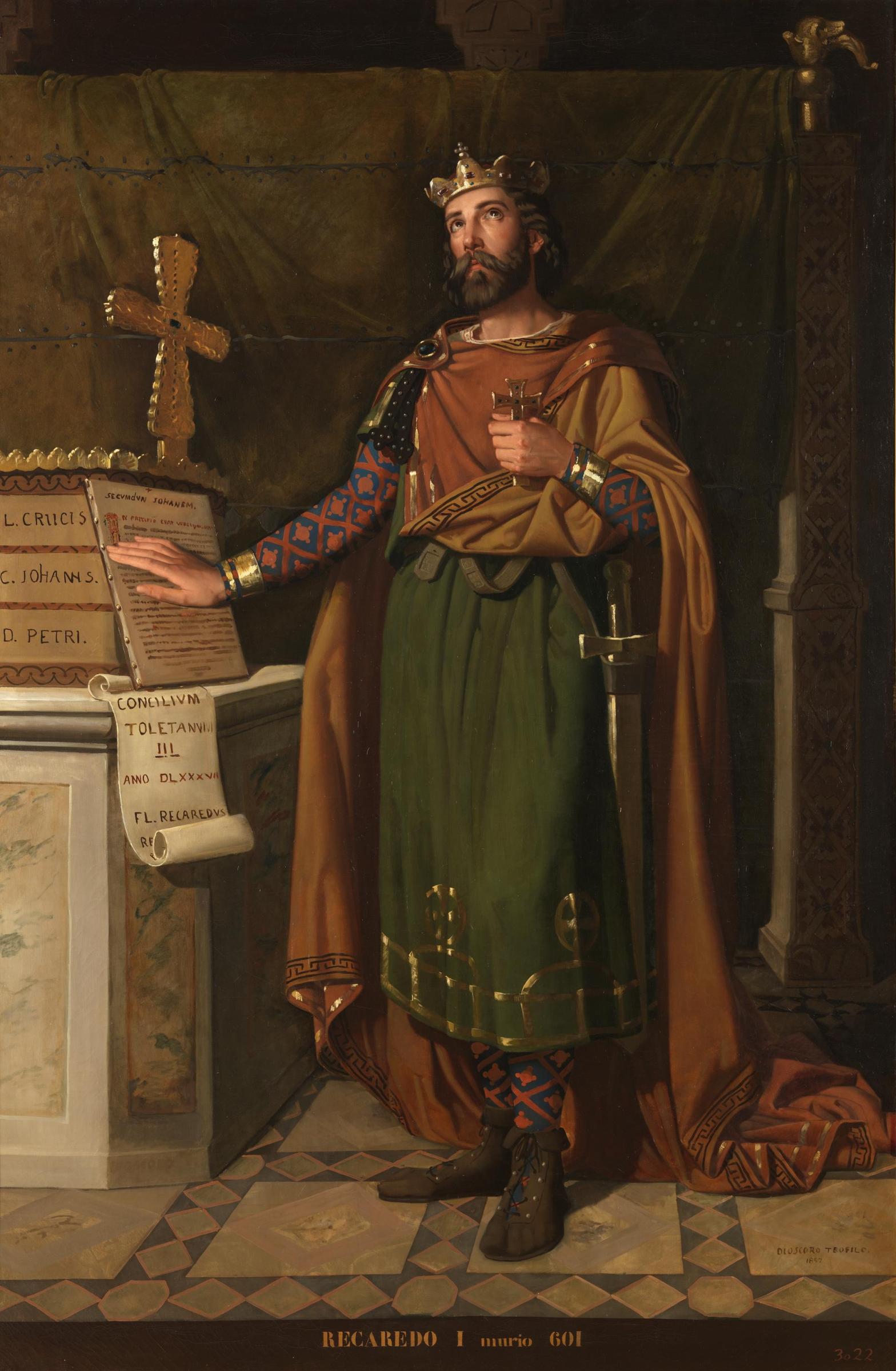
Come learn about church councils, religious uprisings, and the importance of a fancy hat in this episode, where we rank and review Reccared!
Listen to Recarred’s episode on Podbean
Categories
Conquistadores
Reccared didn’t conquer any new territory, but he did fight a lot. Isidore puts it like this: “He seemed not so much to be waging wars as to be exercising his people to keep them fit.” He fights both with the Franks and with internal enemies, and sometimes both at the same time, as we saw in 589.
We don’t have any news on conquest of Byzantine or Basque territories, and he doesn’t actually conquer any Frankish lands – it’s all defensive fighting.
Score
Peter: 3
Sarah: 2
Total: 5
No Me Digas
Isidore reports that Reccared was kind and mild, which is very nice and very boring. The Third Council of Toledo even includes prohibitions on singing burial songs, beating your chest at funerals, and dancing on saints’ days, so you know, he seems like a real fun sponge.
It’s suggested by Isidore that Queen Baddo was Recarred’s concubine, and when Recarred becomes king without a wife, they get married in a hurry to make Liuva’s birth legitimate.
However, we can’t leave this section without talking about Recarred’s treatment of the Jews. One of the constants of the Councils of Toledo is the stating and re-stating of laws and prohibitions that pertain to only Jews. They wax and wane in their severity and actually the strictures in the Third Council of Toledo aren’t the worst that we will see, but that doesn’t mean that they weren’t there and don’t reflect a bigotry against Jewish people.
So, in the Third Council of Toledo, it is mandated that Jews may not have Christian wives, concubines, or slaves, and that if they do and produce children, those children should be baptized. It also prohibits Jews from holding a post where they would have to punish Christians, such as being a judge. Neither of these strictures probably bothered the Jewish population very much, since a child has to be born to a Jewish mother to be considered a Jew, and few Jewish people held public posts anyway. But it is the beginning of some pretty horrible laws coming down the pike.
Score
Peter: 3
Sarah: 3
Total: 6
Ortodoxia
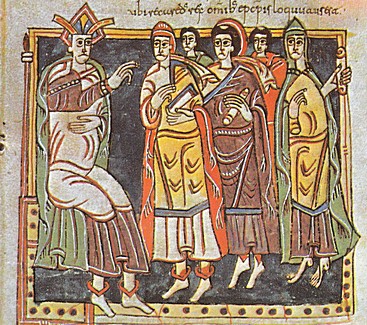
Reccared converted from heresy to orthodoxy, so he’s gotta score well in this round. Now, I have no idea whether this actually happened, because it sounds like a trope, but Gregory of Tours reports that Reccared converts to Catholicism after convening a debate between himself and several bishops in 587. Also, according to Isidore, he restores personal and church wealth that had been confiscated by his father Leovigild.
The Third Council of Toledo also shows support of orthodox beliefs, apart from the statement of faith at the beginning. It recognizes that under Arianism, bishops had been allowed to marry, and lays down the process of what those bishops should do now that they are Catholic (live chastely with your wife, live separate from your wife if you can’t handle that, or separate/get an annulment). Interestingly enough, there are also canons that deal with pagan practices, such as the ban on worshipping idols.
Score
Peter: 7
Sarah: 7
Total: 14
El Rey-sto


Children: 1, possibly 3
Length of Rule: 15 years
Death: Natural
Score
Peter: 4
Sarah: 4
Total: 8
¿Fuero o Fuera?

Sources
Primary
Chronicle, John of Biclaro. As translated in Wolf, Kenneth Baxter (1999). Conquerors and Chroniclers of Early Medieval Spain.
History of the Franks, Gregory of Tours. As translated in Brehaut, Ernest (1916). A History of the Franks.
Proceedings of the Third Council of Toledo. Included in Remie Constable, Olivia (1997). Medieval Iberia: Readings from Christian, Muslim, and Jewish Sources.
Secondary
Thompson, E. A. (1969). The Goths in Spain.
Collins, Roger (1995). Early Medieval Spain: Unity in Diversity, 400-1000.
O’Callaghan, Joseph F. (1975). A History of Medieval Spain.
Recommendations
A Libertarian Walks Into a Bear: The Utopian Plot to Liberate an American Town (And Some Bears), by Matthew Hongoltz-Hetling
Teaching to Transgress, by bell hooks
 The Spanish ArPodA