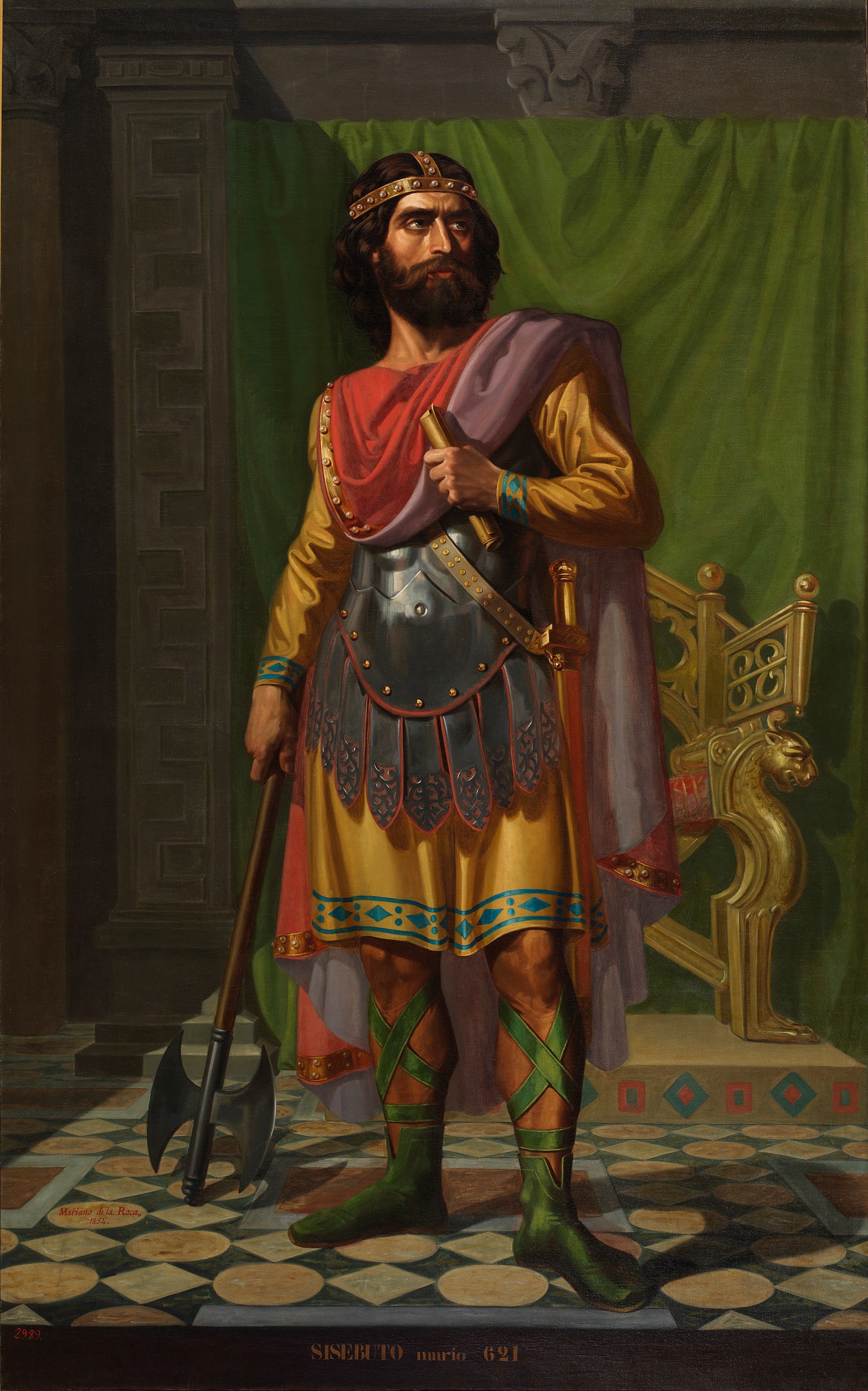
After Gundemar the Forgettable, the pious Sisebut takes the throne. But was he pious, or was there something darker there? Hear about battle-observing from a yacht, eclipses, being the Chief Piety Scold, and whether we award Sisebut the Fuero!
Listen to Sisebut’s episode on Podbean
Categories
Conquistadores
In late 612, there is an uprising in Asturias. A tribe called the Ruccones is in revolt in one of the isolated pockets of the northwest of Spain, and Sisebut sends his generals Richila and Suintila to deal with the uprising, which they do.
In 613 he goes to war against the Cantabrians and the Basques. We’re not sure how these battles shook out, but we know that Sisebut is at these battles in person, because in 613, he writes a poem about eclipses which mentions that he’s watching the fighting from the Visigothic fleet. He writes:
We hear nothing other than the inconvenient noise of iron and the shouts of thousands of soldiers; the exhortations of the generals rouse us and the clamors of war resound in the forum. The trumpets blare and we fly over the water; the Basque comes from the snows and the Cantabrian from his mountains and they give us no rest, and it is precisely us whom are ordained to surround our foreheads with the laurels of the Sun and to braid the most august ivy into our hair.
He dedicates this poem to Isidore.
614-15 is a landmark couple of years for Sisebut, because it is here that he pulls off an almost-total conquest of the Byzantines. General Suintila is the star of these two campaigns, and the biggest take is the city of Málaga, on the southern coast. Despite his victories, though, Sisebut really hates war. Fredegar reports that Sisebut says “Woe is me, that my reign should witness so great a shedding of human blood”. After 2 straight successful campaigns, the Byzantine governor Carsarius appeals to Sisebut to stop the shedding of so much Catholic blood. He offers up a prisoner exchange to seal the deal, Sisebut agrees, and the Byzantines remain on the Iberian peninsula.
Score
Peter: 6
Sarah: 5
Total: 11
No Me Digas
Unfortunately, this section is going to be dominated by anti-Jewish laws. We saw the beginnings of anti-Jewish legislation in Reccared’s canons in the Third Council of Toledo, which restricted Jewish-Christian marriages and forbade Jews from holding public posts. After those laws were passed, Liuva, Witteric, and Gundemar promptly shoved the papers in a back closet and did not enforce them. It seems pretty obvious that these laws were not very popular among the Spanish population, considering how little they were enforced. Sisebut hates this, and he enacts an official set of laws, as well as puts some things into practice that did not have full sanction.
So, the law goes one step further than Reccared’s in forbidding any Jewish person from owning a Christian slave and mandating that Jews must sell any Christian slave they own to a local Christian, or free them. This had to be done before June 1, 612, so it was very early in Sisebut’s reign. It also harshens the penalty for anyone proselytizing the Jewish faith – anyone who converted TO Judaism would be publicly whipped and have their head shaved before becoming enslaved. Reccared’s law on mixed marriages was also strengthened: if the Jewish partner did not convert to Christianity, he or she would be exiled for life.
He didn’t stop there, though. 4 years later, Sisebut began forcibly converting Jews, not just those in mixed marriages or the children of such. We don’t have any idea of how these forced conversions came about. This was the most controversial of Sisebut’s anti-Jewish actions. Probably the reason he didn’t get a council of the church or of the nobles to sign off on this as a law is because forcible conversion is strictly forbidden. There are several incidents of local clergy and nobles helping Jews keep their property and shunning those who converted to Christianity, so that conversion would not seem attractive to other Jews – the exact opposite of what Sisebut was going for.
However, resistance only goes so far. The Fourth Council of Toledo, which is coming up, will look back on Sisebut’s actions and condemn them, restating that forced conversions are, but those Jews who had converted, even by force, would have to remain Christians for the rest of their lives, or be punished as backsliders if they returned to the practices of their heritage.
Score
Peter: 6
Sarah: 6
Total: 12
Ortodoxia
He’s one of our more pious kings, but not everything he did was completely orthodox. He meddled in bishop’s appointments, he had an illegitimate son, he used a saint’s life to throw shade at his enemies . . .
And then there’s the matter of the forced Jewish conversions. This was actually something forbidden by the Catholic Church. You are not meant to force someone to convert to Christianity because then you can’t be sure whether the person is actually saved, or just pretending so that they won’t be tortured or murdered.
Score
Peter: 4
Sarah: 4
Total: 8
El Rey-sto


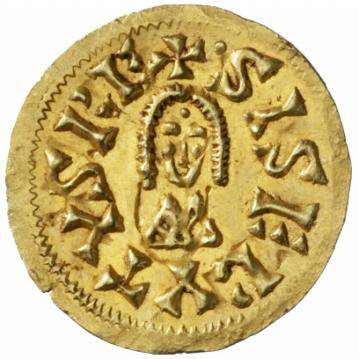
Children: 2
Length of Reign: 9 years
Death: May have been poisoned
He ordered the Church of St. Leocadia to be built in Toledo – this is where several future Councils of Toledo will be held.
He also is the first king so far to leave behind some literature – the astronomical poem about eclipses he writes for Isidore to thank him for the scientific tome “De natura rerum” he had written in about 613. He also leaves behind many letters, as well as The Life of Saint Desiderius. He’s Isidore of Seville’s sponsor, so we have him to thank for not only the History we’ve been using for the last several kings, but a whole trove of other scientific and religious writings.
Score
Peter: 4
Sarah: 5
Total: 9
¿Fuero o Fuera?
Sources
Primary
The History of the Kings of the Goths, Isidore of Seville. As translated in Wolf, Kenneth Baxter (1999). Conquerors and Chroniclers of Early Medieval Spain.
Chronicle, Fredegar. As translated in Wallace-Hadrill, J. M. (1960). The Fourth Book of the Chronicles of Fredegar.
The Life of Saint Desiderius, Sisebut. As translated in Fear, A. T. (1997). Lives of the Visigothic Fathers.
Secondary
Thompson, E. A. (1969). The Goths in Spain.
Collins, Roger (1995). Early Medieval Spain: Unity in Diversity, 400-1000.
O’Callaghan, Joseph F. (1975). A History of Medieval Spain.
Recommendations
Osteria Mozza and Chabelita Tacos – Restaurants in LA
Bearing the Cross, by David J Garrow
 The Spanish ArPodA