
After co-ruling with his father for a few years, Reccesuinth is king! Come hear about celebrity baby names, saying “up yours” to some bishops, and dying in a villa when we review Reccesuinth.
Listen to Reccesuinth’s episode on Podbean
Categories
Conquistadores
The Chronicle of 754 tells us that when Reccesuinth is crowned, there’s a solar eclipse, which terrifies everyone and foreshadows an attack by the Basques. I am not sure why we suddenly got all spooky about eclipses, considering that Isidore and Sisebut knew all about them and wrote poetry about them, but anyways being written 100 years later means that the Chronicle’s foreshadowing is correct, and the Basques do attack in the year 652.
This attack is actually an example of chickens coming home to roost. The attack is led by one of the “refugae”s – remember that these are noble Goths who have left Spain and are now setting up in a foreign country and preparing to attack the Goths with foreign help. We’ve heard several councils of Toledo try to deal with this problem by enacting punishments of varying harshnesses against these people, and then Chindasuith decided to take the gloves completely off and changed the penalties for conspiring with foreign enemies to death. This apparently still does not solve the problem, because towards the end of Chindasuith’s life and not long after Reccesuinth takes the throne, a refugae named Froya rises up against the kings with Basque help. We don’t know if Froya has left Spain to escape Chindasuinth, or if he went into in exile from an earlier king like Chintila, and only just now has garnered enough support. He and his Basque army storm down from the mountains and lay waste to northern Spain, eventually seiging Zaragoza. Fortunately, Reccesuinth arrives and breaks the siege, and Froya’s rebellion is defeated and scattered.
I do want to say something political here. Giving the nobles voting power at the Councils of Toledo is not just an interesting governmental development – it means that for the first time, Goths outnumber Hispano-Romans when it comes to deciding matters of state in this way. The Goths have been Catholic for about 70 years now, and most bishops still come from the Hispano-Roman population, who have been Catholic for hundreds of years. There are definitely MORE Gothic bishops than there were before, but in all of the previous councils of Toledo, the majority of people deciding on the fate of the kingdom have been Hispano-Romans.
Score
Peter: 4
Sarah: 3
Total: 7
No Me Digas
The anti-Jewish laws do come along with the new law code – most focused on Jewish practices rather than belief/church attendance.
Score
Peter: 4
Sarah: 3
Total: 7
Ortodoxia
He founded a church in 661 – San Juan de Baños. The arch above the chancel reads that it was dedicated by “King Reccesuinth, lover of thy name.”
He’s also another one of the kings that had a votive crown discovered in the Treasure at Guarrazar.

Score
Peter: 1
Sarah: 2
Total: 3
El Rey-sto
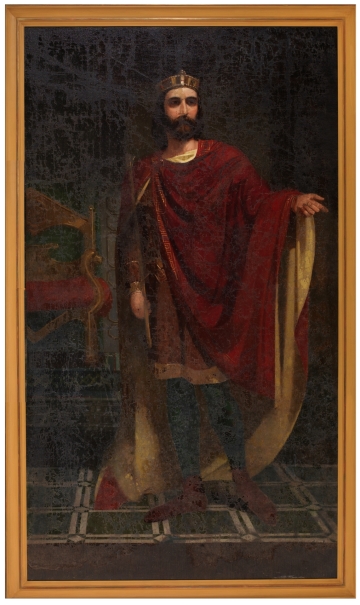


Children: None that we know of
Length of Reign: 19 years as sole king
Death: Natural, in a villa.
Score
Peter: 4
Sarah: 5
Total: 9
¿Fuero o Fuera?
Sources
Primary
The Chronicle of 754. As translated in Wolf, Kenneth Baxter (1999). Conquerors and Chroniclers of Early Medieval Spain.
Chronicle, Fredegar. As translated in Wallace-Hadrill, J. M. (1960). The Fourth Book of the Chronicles of Fredegar.
Secondary
Thompson, E. A. (1969). The Goths in Spain.
Collins, Roger (1995). Early Medieval Spain: Unity in Diversity, 400-1000.
O’Callaghan, Joseph F. (1975). A History of Medieval Spain.
Recommendations
A Witch Hunt cocktail
The 1950 Census
 The Spanish ArPodA