
Égica is on the throne, and we know one thing: Boy, does he hate his in-laws. Hear about how many people is not enough to put into boiling water, the first instance of PLAGUE, and why the Byzantines are over in the West again in Égica’s episode!
Listen to Égica’s episode on Podbean
Categories
Conquistadores
In the year 693, a rival noble named Suniefred seizes power in Toledo. Not only is he able to mint coins, he is also consecrated by the new metropolitan of Toledo, Sisbert. The conspirators have just gotten to the point where they are conspiring to assassinate the king when Egica shows up to take care of the uprising. We don’t have any records of battles, but we do have the Sixteenth Council of Toledo, which names the conspirators and sets out punishments. Not surprisingly, several members of Ervig’s family as well as the dowager queen Liuvigoto are listed as implicated in this uprising. Historians aren’t sure whether that is actually the case, or whether Egica just uses this usurpation as an excuse to get rid of more of his ex-wife’s family. Other rivals are also purged at this point – Chindasuinth’s son Theodefred, remember him? He’s blinded as a result of this spate of punishment. Sisbert himself is defrocked.
Then there’s the Muslims. They’ve taken Carthage by this point, which is more or less modern day Tunisia, and this has caused problems with the Byzantine Empire, so they’re active on the Spain side of the Mediterranean again. The Byzantine fleet goes so far as to attack the coast of Spain, and their onslaught is repudiated by a local lord named Theodemir.
Score
Peter: 2
Sarah: 2
Total: 4
No Me Digas
So everyone meets up in early 688 to do some political business. But Egica’s request for council business surprises them. Egica states that he has called the bishops and the nobles together to help him with a problem. He reminds them of the two oaths he had sworn to Ervig: to protect Ervig’s family and to do justice to the Spanish people. Egica then claims that these oaths are contradictory, and he must be released from one of them. Obviously he is expecting the council to release him from his oath to protect Ervig’s family, and he clearly has been planning this. Marriage or not, he isn’t interested in healing any rifts and he wants to do away with his own family’s rivals. There is even a story that Wamba encouraged Egica to do this from his forced monastic retreat, but this is unlikely – Wamba was probably dead by this point. The point stands, though: as a member of the opposing noble faction, Egica wants to get rid of Cixilo and Liuvigoto, as they represent a power base outside of his control.
Only one problem with his dastardly plan, though. The Fifteenth Council of Toledo, being held in the year 688, is headed by the metropolitan of Spain: Julian. He’s appalled at this maneuver to try to dispatch the family of his former ally. He argues that the two oaths are not contradictory and that although justice for the people of Spain is the higher responsibility, Egica is still bound to protect the family of the former king and can only punish them if they are tried and found to have violated an actual law. The rest of the council agree, and Egica is ordered to love his family.
Egica is a patient man, though. In the year 690, Julian dies, and Egica calls a small, provincial council of just the bishops of Tarraconensis to meet in Zaragoza. They pass a resolution to send Liuvigoto to a convent without her consent, in direct violation of the Thirteenth Council of Toledo. Then, Egica repudiates his wife.
Egica in general is a big fan of harsh punishments. For example, he mandates that anyone arrested for theft of any amount is to undergo a trial by boiling water. He publishes laws that deal harshly with fugitive slaves. Worst of all are his anti-Jewish laws. He makes it a crime for Jewish merchants from outside of the country to do business with Christians, orders that all Jews be enslaved, and that their children be taken from them at the age of 7 to be raised as Christians. The Chronicle of 754 summarizes him pretty well by saying, “Egica persecuted the Goths with bitter death.” Notably, none of these punishments, from the boiling water to the child kidnapping, were enforced anywhere outside of Toledo – which really shows you how far the power of the kingdom has fallen since the days of Wamba.
Score
Peter: 6
Sarah: 6
Total: 12
Ortodoxia
Nothing notable.
Score
Peter: 1
Sarah: 1
Total: 2
El Rey-sto
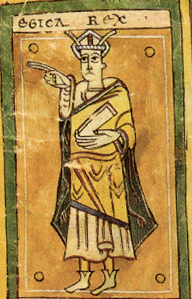


Children: At least 1
Length of Reign: 10 years as sole king
Death: Natural
Score
Peter: 3
Sarah: 3
Total: 6
¿Fuero o Fuera?
Sources
Primary
Proceedings of the Fifteenth, Sixteenth, and Seventeenth Councils of Toledo. Excerpted in Thompson, E. A. (1969). The Goths in Spain.
The Chronicle of 754. As translated in Wolf, Kenneth Baxter (1999). Conquerors and Chroniclers of Early Medieval Spain.
The Chronicle of Alfonso III. As translated in Wolf, Kenneth Baxter (1999). Conquerors and Chroniclers of Early Medieval Spain.
Secondary
Thompson, E. A. (1969). The Goths in Spain.
Collins, Roger (1995). Early Medieval Spain: Unity in Diversity, 400-1000.
O’Callaghan, Joseph F. (1975). A History of Medieval Spain.
 The Spanish ArPodA